Architecture · Makkah Province
Historic Jeddah
For centuries Jeddah connected the Indian Ocean world with Makkah. Within its historic centre, coral-stone tower houses, shaded lanes, merchants’ compounds and projecting wooden rawashin preserve the character of a Red Sea port shaped by pilgrimage and trade.
The gate to Makkah
In 646 CE Caliph Uthman ibn Affan established Jeddah as the port for Makkah. Its harbour became the maritime threshold through which pilgrims from Africa, Asia and the wider Islamic world continued their journey to the Holy City.
Pilgrimage gave Jeddah a role unlike that of an ordinary trading port. The city received people, ideas, languages and goods from across the Indian Ocean and Red Sea. Consulates, merchants, shipowners and service communities developed around this seasonal movement.
A Red Sea trading city
Jeddah’s commercial importance grew as ships brought textiles, spices, grains, coffee and manufactured goods to its markets. Cargoes were transferred between sea routes and inland caravans, linking oceanic exchange to Makkah and the western Arabian hinterland.
The opening of the Suez Canal in 1869 and the arrival of steam navigation intensified these connections. Prosperous merchant families enlarged their houses and invested in the urban fabric now associated with Al-Balad, the historic centre.
Coral-stone tower houses
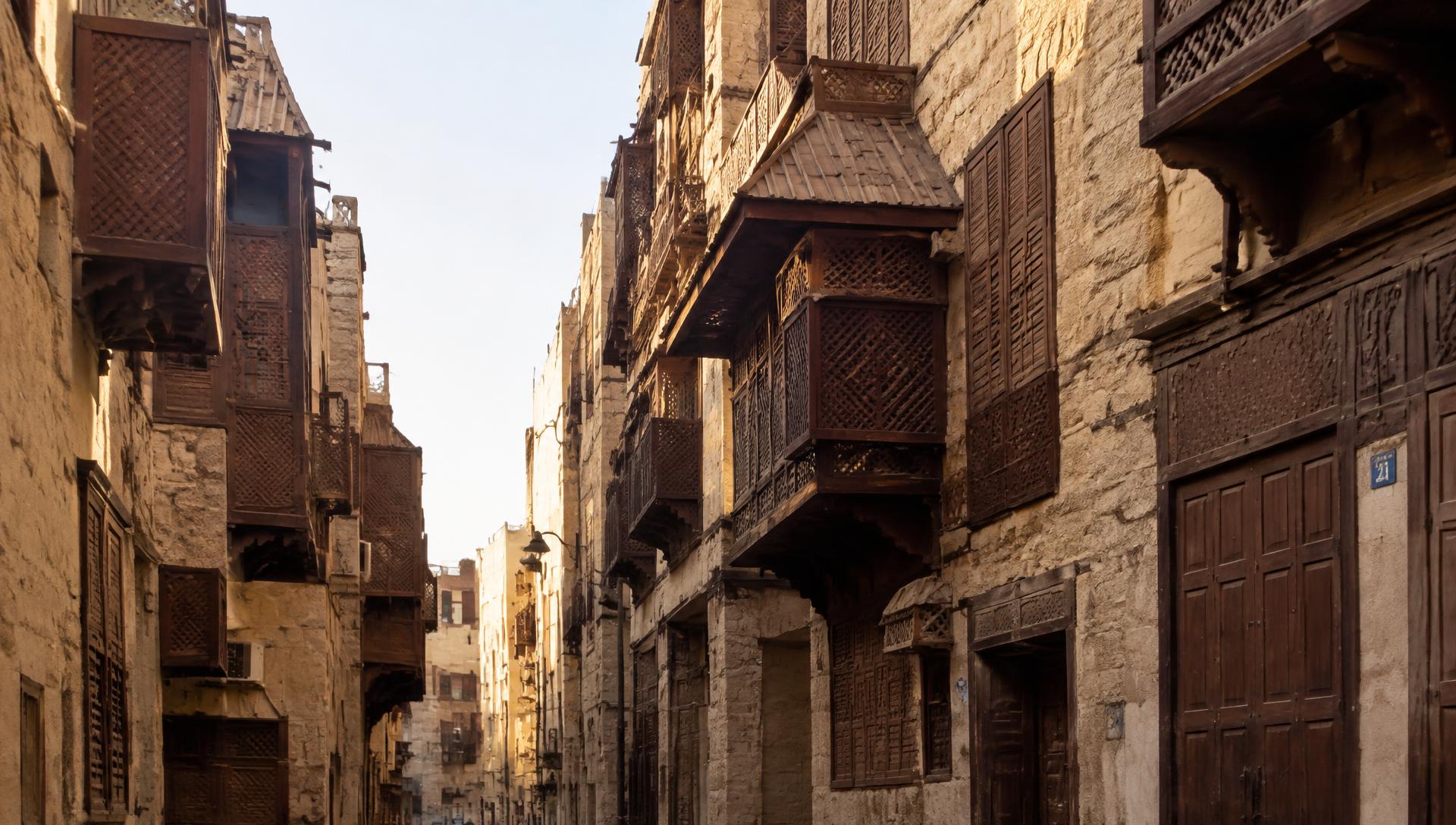
Historic Jeddah’s defining buildings are multi-storey houses constructed from blocks of coral limestone known locally as manqabi stone. Timber courses inserted into the masonry helped distribute loads and gave the walls some flexibility, while lime plaster protected the porous stone.
Building upward made efficient use of limited space within the former city walls. The houses combined reception areas, family rooms, service spaces and terraces across several levels. Their height and close arrangement created a dense skyline quite distinct from the low earthen architecture of inland Najd.
Prominent surviving houses, including Bayt Nassif, Bayt al-Matbouli and Bayt Noor Wali, reveal variations in scale and decoration. They also record the status and cosmopolitan networks of families involved in trade and pilgrimage.
Rawashin: shade, air and privacy
Projecting wooden windows called rawashin are both practical climate devices and the most recognizable feature of Jeddah’s streets. Their lattice screens shade openings, permit air to circulate and allow occupants to look outward while maintaining privacy.
Large rawashin animate entire façades with repeating panels, carved details and shutters. Because good structural timber was not abundant locally, wood arrived through the same trading networks that sustained the city. Architecture therefore made Jeddah’s maritime connections visible in its materials.
Streets, markets and public life
The value of Historic Jeddah lies not only in individual houses. Narrow lanes, small squares, mosques, markets and merchants’ compounds form an urban ensemble adapted to walking, shade and social exchange.
Traditional souqs were organized around trades and commodities, while neighbourhood mosques anchored daily life. The pattern of buildings and open spaces shows how commerce, domestic life and pilgrimage services occupied the same compact city.
Change, conservation and continuity
The demolition of Jeddah’s walls in 1947 signalled a period of rapid expansion beyond the old city. As residents and businesses moved to newer districts, many historic buildings suffered from vacancy, fire, decay and alterations incompatible with coral-stone construction.
Historic Jeddah was inscribed on the UNESCO World Heritage List in 2014. Conservation programmes now combine documentation, emergency stabilization and the repair of houses, mosques and public spaces. The central challenge is to retain a living neighbourhood—one with residents, crafts and commerce—rather than preserve the district only as a collection of monuments.
Sources
- 1.Historic Jeddah, the Gate to Makkah — UNESCO World Heritage CentreUNESCO