First Saudi State · Riyadh Province
Diriyah and At-Turaif
On the banks of Wadi Hanifah, Diriyah became the seat of the First Saudi State in the 18th century. Its At-Turaif district preserves an exceptional ensemble of Najdi palaces, houses and defensive works built from the earth of central Arabia.
A settlement shaped by the wadi
Diriyah developed along Wadi Hanifah, a fertile corridor of wells, date gardens and seasonal watercourses west of modern Riyadh. The settlement’s position joined agricultural resources to routes crossing the Najd plateau, creating the conditions for a durable political and religious centre.
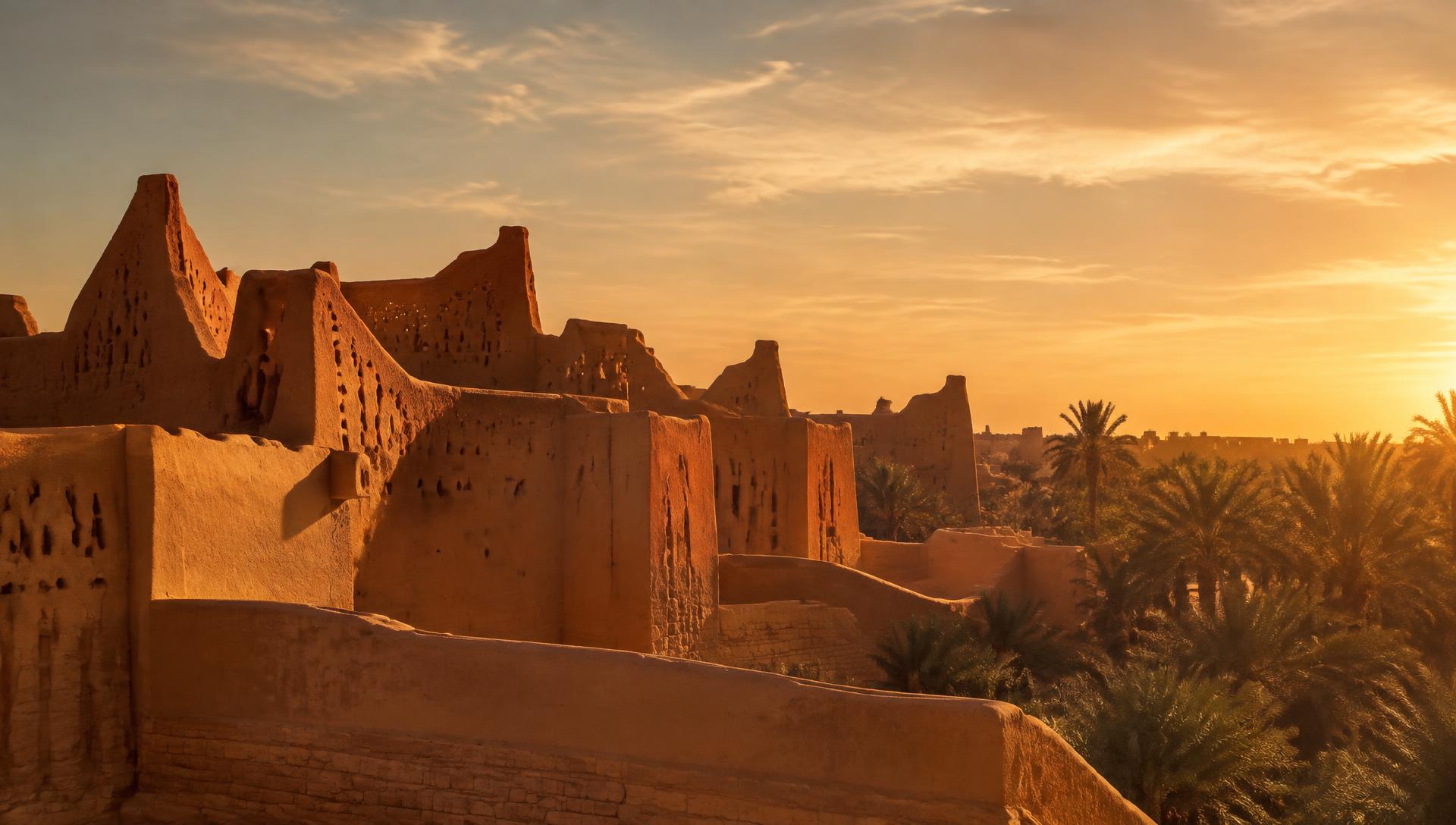
The historic oasis was not one continuous mass of buildings. Communities occupied distinct quarters along the valley, while At-Turaif rose on a limestone escarpment above the wadi. Its elevated position offered protection and gave the ruling district a commanding presence over the gardens and settlements below.
The First Saudi State
In 1727 Imam Muhammad bin Saud assumed power in Diriyah, a date recognized as the foundation of the First Saudi State. From this capital, authority expanded across much of the Arabian Peninsula during the 18th and early 19th centuries.
At-Turaif became the state’s political heart. It contained royal residences, administrative spaces and the Imam Muhammad bin Saud Mosque. The growth of these institutions transformed a local Najdi settlement into a capital whose influence extended far beyond Wadi Hanifah.
Building in the Najdi tradition
UNESCO identifies At-Turaif as an outstanding example of the Najdi architectural and decorative style. Builders formed thick load-bearing walls from sun-dried mud brick, often set on stone foundations, and used tamarisk or palm trunks to span roofs. Earthen plaster helped protect exposed surfaces and could be renewed as part of regular maintenance.
Palaces and houses were organized around courtyards that brought light and air into inward-looking interiors. Small openings, shaded passages and substantial walls moderated the extremes of the desert climate. Triangular ventilation openings, geometric decoration and crenellated rooflines gave the district a distinctive visual language.
Salwa Palace, the largest complex at At-Turaif, grew through several building phases. Rather than a single monumental block, it is a connected sequence of reception rooms, courtyards, domestic areas and circulation spaces that records the expansion of the ruling household.
Siege, destruction and a new capital
In 1818 an Ottoman-Egyptian army commanded by Ibrahim Pasha besieged Diriyah at the end of a prolonged military campaign. The surrender and destruction of the capital brought the First Saudi State to an end and left much of At-Turaif in ruins.
A Second Saudi State was established in 1824 with Riyadh as its capital. Diriyah remained historically important, but the ruined palaces of At-Turaif were no longer the centre of government. Their abandonment also preserved archaeological evidence of the district’s earlier form.
Conservation and World Heritage
At-Turaif was inscribed on the UNESCO World Heritage List in 2010. The designation recognizes both its association with the First Saudi State and its exceptional testimony to Najdi architecture at the centre of the Arabian Peninsula.
Conserving earthen architecture requires a different approach from repairing stone monuments. Walls must be stabilized with compatible materials, drainage must be controlled and new work must remain distinguishable without disrupting the site’s character. The wider Diriyah programme has made the district accessible through museums, paths and interpreted ruins while continuing archaeological research and conservation.
Sources
- 1.At-Turaif District in ad-Dir'iyah — UNESCO World Heritage CentreUNESCO
- 2.Founding Day (22 February 1727) — Saudi Press AgencyGovernment
- 3.King Abdulaziz Foundation for Research and Archives (Darah) — Darat al-Malik AbdulazizArchive